Gardners Art Through the Ages Apollo Attended by the Nymps
| |


French sculpture has been an original and influential component of world fine art since the Middle Ages. The first known French sculptures appointment to the Upper Paleolithic age. French sculpture originally copied aboriginal Roman models, then plant its own original form in the ornamentation of Gothic architecture. French sculptors produced important works of Bizarre sculpture for the decoration of the Palace of Versailles. In the 19th century, the sculptors Auguste Rodin and Edgar Degas created a more than personal and non-realistic manner, which led the fashion to modernism in the 20th century, and the sculpture of Pablo Picasso, Georges Braque, Marcel Duchamp and Jean Arp.
Prehistory [edit]
The primeval undisputed examples of sculpture belong to the Aurignacian culture, which was located in Europe and southwest Asia and active at the beginning of the Upper Paleolithic. As well as producing some of the earliest known cavern art, the people of this culture developed finely-crafted stone tools, manufacturing pendants, bracelets, ivory chaplet, and bone-flutes, likewise as three-dimensional figurines.[one] [2]
Two of the largest prehistoric sculptures can be found at the Tuc d'Audobert caves in France, where around 12–17,000 years ago a sculptor used a spatula-like stone tool and fingers to model a pair of large bison in clay against a limestone rock.[3]
Human being forms and animals were common in the early sculpture, often in the form of bas-relief. Figures expressed emotion, and were oftentimes distorted; the forms of women were ofttimes strangely obese. The Venus of Laussel is ane of the earliest examples.[four] With the start of the Mesolithic the amount of figurative sculpture diminished, and animals predominated, expressing mobility and vigor.[4] In the later Mesolithic period, the sculpture became less realistic and turned toward abstruse, ornamental deocrative forms, which continued through the Statuary Age and the Iron Age. The arrival of the Celts, Ligures and Iberian peoples did not radically change the mode. Human forms were ordinarily carves simply as stylized silhouettes. On the coast of the Mediterranean, sculptors made friezes of warriors and various deities seated with their legs crossed.[4]
-
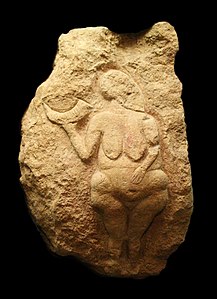
Venus of Laussel c.25,000BCE, an Upper Palaeolithic etching, Bordeaux museum, France
-

Gallo-Roman and Carolingian [edit]
The Roman conquest of Gaul imposed the Roman style, featuring realism and celebration of grandeur and power. Gallo-Roman sculptors of Gaul modified the Roman style to make information technology more than frail and personal. Sculpture flourished in the form of statuettes, statuary vases, and subjects on domestic and religious themes. Early Christian symbolism soon appeared in sculptural works such every bit sarcophagi, but it was largely discouraged by church leaders who feared a return to the worship of idols.[5]
Gallic sculpture showed the influence not merely of Roman sculpture, but likewise of Hellenic sculpture, from workshops in central Italia. One feature instance is the statue of Medea in the Museum of Arles, from the 1st century.[half-dozen]
The invasion of Roman Gaul past the Burgundians, Celtes, Visigoths slowed the development of sculpture beyond traditional decorative designs. The age of Charlemagne restored a certain prestige to the arts, but the sculpture was not original or skilled, and afterward the decease of Charlemagne little of import sculpture appeared until the reign of the Capetian dynasty (987–1328)[v]
-

Relief of Romans in combat, Mausoleum of the Julii, Glanum (Saint-Rémy de Province), 35-25 BCE
-

Statue of Medea, limestone, 2nd century Advert, Musée de l'Arles Antique, Arles
-

A Gallo-Roman sarcophagus from Rignnieux le Franc, Ain (end of 4th century)
Romanesque sculpture [edit]
Under the Capetian dynasty, the Kingdom of French republic was gradually returned to calm, stability and prosperity. A reform of the church building and the founding of new religious orders led to important commands for sculptures, especially for the new Cluny Abbey (1088–1108) of the Benedictine gild. Other Abbeys beyond France imitated its employ of sculptural decoriation.
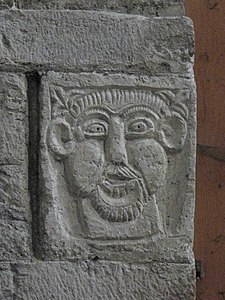
The earliest sculptural decorations on altars and the interior surfaces of churches, on lintels, over doorways and peculiarly on the capitals of columns, which were normally adorned with images of biblical figures and real or mythical animals. Nigh of the piece of work was near apartment with little attempt at realism. Some of the earliest Romanesque sculpture in France is found at Saint-Génis-des-Fontaines Abbey (1019–1020) in the eastern Pyrenees. A lintel over a doorway portrays Christ on a throne, in a frame supported by ii angels, and flanked past the apostles, The forms of the apostles are defined past the shapes of the arches into which they are squeezed.[7] This "Christ in Majesty" design over the central doorway became a common feature for churches and Cathedrals across French republic in the Romanesqua dn Gothic period.[8]
In the later Romanesque menstruation, sculpture was often used to at the most of import points, such as the facades, to emphasize the lines of the structure. Information technology often used geometric designs (circles, squares, triangles). Spaces were crowded with figures, which were often contorted so they seemed to be dancing. The sculpture was virtually profuse on the capitals of columns and on the portals, where it was used to nowadays very complex and extended biblical stories. Sculptors also depicted a big number of animals, both real and imaginary, including chimeras, sirens, lions, and a broad range of monsters. Imagination usually prevailed over realism.[nine]
The southwest of French republic, around Toulouse, had a particular style, more vivid and active than the north. A remarkable group of Romanesque sculpture is establish in the decoration of the Basilica of Saint-Sernin, Toulouse in Toulouse, dating to the late 11th and early on 12th century. The figures are much more than realistic, and make skillful apply of shadows and light to bring out the details. One of the most distinctive works is the chantry table, signed by its sculptor, Bernardus Geldvinus. He too made the seven sculptural reliefs found in the ambulatory of the cathedral.[7]
Other remarkable examples of Romaesque sculpture are establish on the tympanum and the capitals of the columns of the cloister of Moissac Abbey in Mossac, Tarne-et-Garonne, and the columns of the abbey church of Saint-Marie}} in Souillac in the Lot Department. Sculptors in Burgundy as well produced distinctive works for the ornament of the churches there, particularly for Saint-Philibert de Tournus Abbey (about 1100). The Typanum of Vézelay Abbey, a pilgrimage church dedicated by the Pope in 1132, shows the country of the art of Romanessque sculpture at the cease of the Romanesque and offset of the Gothic catamenia.[7]
-
-

Typanum of the southwest portal of Moissac Abbey (11th-twelfth century)
-

-

Statue-Reliquary of Saint Foy, in Conques, gold and silver plaques over wood (9th-10th century)
Gothic sculpture [edit]
At the beginning of the 12th century, a renewal of sculptural styles began in France. During years of peace, the birthrate had profoundly increased, and larger churches and cathedrals were needed. The cathedral replaced the abbey as the major religious institution, and the Bishop replaced the Abbot as the primary figure determining artistic style. The interiors of churches were higher, with larger windows, and filled with light, calling for a different kind of sculpture. The exteriors were besides much higher, and needed statuary visible and readable from down below. Sculptors abandoned the exotic foliage borrowed from before sculptural styles, such every bit the acanthus and palmetto, in favor of more local forms, such as the grape foliage and oak leaf blueprint. The human forms were no longer twisted and tortured to fit the infinite; they took on a more natural appearance. The sculpture was expected to be a book written in stone, for the worshippers to read. Abbot Suger, who directed the construction of the starting time Gothic abbey in Saint-Denis, observed, "Fine art conducts human being souls by the employ of material things to reach the immaterial." One Gothic sculptural innovation, borrowed from the ancient Greeks, was the column in the course of a human being figure, Some other was the use of sculpture of diverse mythical creatures, such as the gargoyle and the chimera, to warn the faithful of the dangers outside the church. (The gargoyles likewise had the practical application of projecting pelting h2o abroad from the walls.)[10]
Renaissance [edit]
In the 14th century, Archeological excavations in Rome and Florence led to the rediscovery of classical statuary, and the beginning of the Renaissance. Minor bronze models of the classical works were imported and sold to wealthy French patrons, and French artists began to visit Italy to see for themselves. Charles Eight brought artists from Naples and Florence to Paris. Louis XII employed Italian sculptors. Francis I invited Leonardo da Vinci, Francesco Primaticcio and Benvenuto Cellini to work in France. They formed new style and school of art, the School of Fontainebleau, for the decoration of his chateau. He sent Primaticcio back to Italian republic to acquire molds of classical sculpture; he returned with 133 cases of sculpture. Despite this Italian competition, the best-known French sculptors, including Ligier Richier and Michel Colombe, continued to work in the traditional Gothic way, especially in the statuary of tombs. Michel Colombe made an elegant Tomb of Francis Ii, Duke of Brittany (1502–07) with a statue of his daughter, Anne of Brittany, as Prudence at his side. Richier fabricated a particularly Gothic sculpture of a martyred saint, the Cadaver Tomb of René of Chalon portraying René of Chalon every bit he would await three years subsequently his death, a decayed corpse holding his own centre in his hand.[11]
The first major French sculptor of the Renaissance was Jean Goujon (1510–1565), too a noted graphic illustrator, whose work in bas-relief perfectly captured and refined the Italian style. He arrived in Paris in 1544 and worked closely with the architect Pierre Lescot on the decoration of the Louvre, the Fontaine des Innocents, several figures for the facade of the Hôtel de Ville, Paris, and a group of bas reliefs of the 4 Seasons, made for the courtyard façade of the hôtel of Jacques de Ligeris, now in the Musee Carnavalet in Paris. Goujon was a Protestant, and in 1562, when the French Wars of Religion began, he left France for Italian republic, where he is believed to accept died in 1563.[eleven]
Other notable sculptors of the French Renaissance included Pierre Bontemps (1505–1568), collaborator with architect Philibert Delorme. He was the principal creator of the sculpture of the tomb of Francis I, which displayed his precise cognition of anatomy and his power to vividly portray a multitude of battles, scenes and personalities, in 50-four dissever bas-reliefs around the base of the tomb.[eleven]
Germain Pilon (1535–1590) was another major figure. He was a pupil of Bontemps, a trigger-happy proponent of the Catholic side in the Wars of Faith and Counter-Reform. He was also an excellent portraitist and student of anatomy and item. His major works included a monument for the eye of Henry 2 of France, based on a cartoon of Francesco Primaticcio, the tombs of Henry Ii of France and Catherine de Medicis, and a multifariousness of other religious works.
French sculpture at the terminate of the 16th century was based largely on ancient Roman models. Bartélémy Prieur was a educatee of Pilon and imperial sculptor of Henry Iv, and Jacques Sarrazin was court sculptor for Louis XIII. They studied in Rome and copied Roman models. The two brothers François Angiers and Michel Angiers were as well longtime students in Rome. Their piece of work was highly refined and came close to perfection in execution, but lacked originality, emotion or drama. The major stylistic innovation in French sculpture was the introduction of the equestrian statue of the Rex on horseback, designed for placement in central city squares. The first example was the bronze equestrian statue of Henry IV of France, with the horse by Jean de Boulougne, a French sculptor employed in Florence by the Medicis, and the King by Ferdinando Tacca, his educatee. The statue was destroyed during the French Revolution.[12]
-

Caryatides, Salon des Caryatides, Louvre past Jean Goujon (1550–51)
-
-

The 17th century and the Historic period of Louis Xiv [edit]
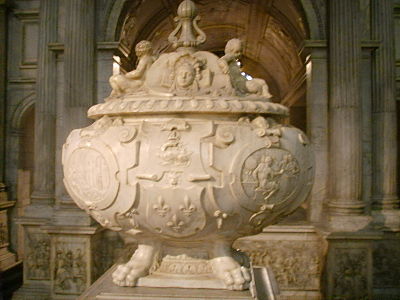
The reign of Louis XIV (1643-1715) largely coincided with the era of Bizarre sculpture, but the French Male monarch resisted the Baroque style. The cracking master of Baroque sculpture, Bernini, fabricated ane trip to Paris, and criticized the work of French sculptors as "a style that is pocket-size, sad, and gloomy." He made a statue of the King, saw his plan for facade of the Louvre rejected, and departed after six months. Louis Xiv and his ministers instead used a more classical style of sculpture as method of illustrating the majesty of the King and his reign. The French Royal Academy of Painting and Sculpture had been created in 1648. The students were given as their guide the King's declaration: "I confide in you the thing well-nigh precious in the world; my fame."[xiii] The King launched 1 of the largest sculptural projects ever, the ornament of the Palace of Versailles and its vast gardens and numerous fountains. Near of the leading French sculptors were occupied in making statuary for Versailles. The majestic artist Charles Le Brun assigned the subjects, the sculptors the models, they were approved by the King, and total-scale models in plaster were created for brandish in the park. After a period of months or years, the terminal works were and so cast in bronze or carved of marble.[fourteen]
The major sculptors who decorated the gardens included François Girardon (1628-1715), Antoine Coysevox (1640-1720) and Jean-Baptiste Tuby (1635-1700). Coyseyvox, besides making fountains, produced very fine portrait busts of the Rex and his chief ministers. He as well created sculptures portraying members of the Court or nobility in mythological costume, such as Duchesse of Burgundy represented as the Goddess of the hunt, Diane. Nearly all the major sculptors of the period, including Coysevox, Girardon, Jean-Louis Lemoyne (1665-1755), and Edmé Bouchardon (1698-1762) also fabricated monumental equestrian statues of the King for imperial squares in the big cities, including Identify Vendôme and Place des Victoires in Paris.
In the later on years of the reign of Louis XIV, wars drained the treasury and large sculptural commissions became scarce. The Male monarch turned his attention to the decoration of his Château de Marly, built as a quieter retreat from Versailles. Statues there included works by Coysevox and his students, including Nicolas Coustou and, before long later his reign, a famous pair of horses by Guillaume Coustou (1739–45), whose replicas at present decorate the beginning of the Champs-Elysees.
Other sculptors of note during the flow include Pierre Puget, from Marseille, i finest sculptors of the French Baroque style. He had studied and worked in Rome, and his works displayed movement and strong emotion, and used the figure serpentine, the upward screw system which suggested movement and lightness, which was characteristic of Italian Baroque sculpture. Seome examples, including Perseus and Andromeda 1684) and Milo of Crotone (1682) were placed in Gardens of Versailles, and are now in the Louvre.[15]
-

Bowl of Saturn from the gardens of the Palace of Versailles, by François Girardon (1672-1677)
Eighteenth Century: Neoclassicism and Rococo [edit]
The two dominant French sculptors of the 18th century were Jean-Baptiste Pigalle and ane of his pupils, Jean-Antoine Houdon. Pigalle failed to get the Prix de Rome, but worked in the studio of François Lemoyne and went to Italy, where he made his commencement famous piece of work, Mercury putting on his running shoes. He made numerous naturalistic sculptures, including Love and Friendship for Madame Pompadour, and a monument of Louis Fifteen on horseback for the urban center of Reims. He broke away from the common cold formality of classicism with the Tomb of Marshal Maurice de Saxe, ordered by Louis Fifteen, Pigalle portrayed the Marshal not lying on his tomb, but very much alive and active, surrounded by symbolic figures of characters and animals, including banners, a Dutch lioness and an English leopard, and a figure of Hercules in death, symbolizing the Align himself; the sculpture was a scene of theater carved in stone. Pigalle also made very fine portrait statues and busts including a nude statue Voltaire, expressing his modesty and humanity.[14]
Portrait busts became extremely popular. Jean-Antoine Houdon (1714-1785) was a student of Pigalle, and specialized in busts, traveling throughout Europe and to the United States, where he made accurate busts of George Washington and Benjamin Franklin. He measured the faces of his subjects for accuracy, particularly working on the details of the eyes to assure realism and a vivid expression. Augustin Pajou made 5 different busts of Madame Du Barry,[16]
The reign of Louis Fifteen and the patronage of Madame de Pompadour brought a plough toward neoclassicism. Major royal commissions usually went to the two established official majestic sculptors, Jean-Louis Lemoyne (1665-1755(, and his son, Jean-Baptiste Lemoyne, who was one of the finest portraitists of the catamenia, and to Augustin Pajou, but madame Pompadour gave commissions to a new generation of sculptors, including Étienne Maurice Falconet and Jacques Caffieri. Falconet accomplished international renown; he was invited by the Russian Empress, Catherine the Great, to make a monumental statue of Peter the Great on horseback, known equally The Bronze Horseman, and to Prussia to make statuary for the gardens of Frederick the Dandy at Sanssouci Park in Potsdam.
By the late 18th century, the cliente for sculpture had inverse. The ascent grade of bankers, merchants and other wealthy professionals sought sculpture for their homes. Sculptors worked in a diverseness of mediums, including glazed porcelain from the Sevres Manufactory, which could be made in a series, and fabricated smaller-scale statuary pieces in multiple castings. including multiple castings of bronzes. Major sculptors, including Pigalle and Falconet, made series for the Sevres manufactory. The theatrical rococo style was common; The themes of the small works were usually pastoral, romantic and mythological scenes, with cupids, shepherdesses and satyrs, charm and mild sensuality. Claude Michel, too known as Clodion, was a main of this genre, working mostly in terra-cotta. He composed numerous sculptures of intertwined nymphs, satyrs, and bacchantes in terracotta.[17]
The French Revolution med to the destruction of sculpture on a large scale; the equestrian statues of the Kings and the sculpted facades of Gothic Cathedrals were pulled down or defaced. A few sculptors appeared during the reign of Napoleon, including Chinaud, Chaudet, and Cartellier, but their work was entirely overshadowed past the Italian sculptor Antonio Canova in the same menstruum. Napoleon invited Canova to Paris, where Canova made a semi-nude statue of the Emperor as Mars, but he soon returned to Rome and a more appreciative audience[16]


The Nineteenth Century [edit]
The first major figures of French sculpture in the 19th century were Antoine-Louis Barye (1795-1875) and François Rude (1784-1855), each of whom broke away from the classical models and ideals of the 18th century. Barye was near famous as a portrayer of animals, which he depicted with great realism, often combining in groups with people. His works include sculptural decoration of the July Column in the Place de la Bastille, and four groups on the facade of the Pavillon Denon of the Louvre (1854). Rude's subjects were not nobles but ordinary people, portrayed realistically, not in classical postures. This appeared in is his first important sculpture, of a young Neapolitan fisher-male child (1833), and in his most famous piece of work, The Departure of the Volunteers, (1836), a bas-relief on the base of operations of the new Arc de Triomphe, which became a classic example of the movement of romanticism. His portrait busts of leading personalities, such equally Jacques-Louis David, showed them not idealized, but showing the tiptop of emotion.[xviii]
The sculptor Honoré Daumier (1808-1879) occupied a unique place in 19th century sculpture, with a series of sculptures of portraits of members of the French Parliament that mercilessly caricatured and satirized them.
Jean-Baptiste Carpeaux (1827-1865) was the most eminent French sculptor during the reign of Napoleon III, capturing the spirit of the Second Empire. He studied first with Rude, where he learned precision and naturalism, then, at Rude'southward suggestion, in the more traditional Academy, where he was a student of Barye, he learned the Renaissance style of Michelangelo and won the Prix de Rome. His statue Ugolin, the thinker caused a scandal, which fabricated him famous. With his friend architect Charles Garnier, he made his most famous piece of work of sculptural ornamentation of the facade of the Opera Garnier in Paris, The Genius of the Dance, full of passion and energy, which shocked more than bourgeois Parisians. He likewise fabricated a celebrated work of Flore for the facade of the Louvre, and the statuary for the Fontaine de fifty'Observatoire, to the south of the Luxembourg Gardens.[18]
Jules Dalou (1838-1902) a pupil of Carpeaux, followed him equally an important monumental sculptor, Triumph of the Republic, (1889) marking the centenary of the French Revolution, in the Place de la Nation.
Edgar Degas used sculpture as a tool for his painting. When he died some ane hundred fifty terracotta and wax sculptures of dancers, women at their dressing tabular array, and other subjects were found in his studio. He apparently used these sculptures and models, to study the furnishings of lite. His sculptures, ofttimes delicately colored and with material skirts, captured grace, motility, and character of the dancers equally finely as his paintings.[19]
The about famous French sculptor of the 19th century, Auguste Rodin (1840-1917), wished to be a pupil of Carpeaux, but did not succeed, though he afterwards borrowed i of Carpeaux's subjects, Ugolin, the Thinker. He did become a student of Barye, who was his drawing instructor. His extraordinary abilities of careful observation combined with an ability utilise light, and to limited emotions, very apace made him famous, though information technology likewise quickly brought him criticism. all his major public works were attacked. His almost famous works included The Thinker, The Burghers of Calais, and Balzac. Past the time of the 1900 Paris Exposition, he had so many commands that he served principally equally a modeler, employing a large studio of administration to actually make the statues. He conceived his famous statue, The Thinker, in 1881-1882, and displayed a full-size model in 1904 at the Salon des Beaux-Arts. Twenty-eight castings of the statue were eventually fabricated.[18] Toward the finish of his life, he made an even more influential work, a sculptural portrait of Honoré de Balzac. Rodin was selected for the commission by the writer Emile Zola Rodin experimented with many different versions costumes and poses, beginning in 1891, and finally decided to portray not the physical appearance, but the sprit and thoughts of Balzac, through an exaggeration of his features. The work caused a scandal when it was presented in 1898, and it was rejected by the Salon of the National Guild of Fine Arts. A subscription covered the price of the model, which was put up on Avenue Friedland in 1902. Rodin never saw the final bronze version, which was placed at the intersection of Avenues Raspail and Montparnasse in 1939.[20]
The students of Rodin modified and created new variations, many expressing the sense of movement, speed and alter felt at the end of the century. These sculptors included Rodin's student and lover Camille Claudel (1864-1943).
-

Marechal Ney, 6th arrondissement, Paris, by François Rude, (1836)
-

Jaguar devouring a hare, by Antoine Louis Barye (1850), Walters Gallery
-

Bust of Hippolyte-Abraham Dubois by Honoré Daumier. National Gallery of Art, Washington
-

Trivial Dancer Aged Fourteen, past Edgar Degas (1878–81), National Gallery of Art
-

Twentieth Century - The end of rules [edit]
The years from 1900 until 1914 were a menses of boggling experimentation in sculpture, breaking all previous rules and traditions. Artists from around the earth and from the French provinces were drawn to Paris. Antoine Bourdelle (1861-1929) was a student of Rodin, whose work spanned the two centuries and illustrated the transition to the new styles. His stylized bas-relief sculptures in the Theatre des Champs Elysées (1910–12) blended with the new Art Deco architectural style. Important sculptors in the early century included Aristide Maillol (1861-1944), who began as a painter and switched to sculpture, He particularly portrayed, in natural and sensual form, the female nude. Germaine Richier (1902-1959), a pupil of Bourdelle, made strange hybrids of homo and fauna forms. Her work expressed nervousness and tension.[21]
François Pompon, who had worked in the studio of Rodin, inherited the role of animal sculptor that Bayre had occupied, though unlike Bayrle he had no interest in realism. He simplified and purified the forms, seeking but the essence of the animal.
Many of the major modernist painters of the early 20th century also experimented with sculpture; these included Henri Matisse, André Derain, Fernand Léger, Georges Braque, and others. They had no formal grooming or experience every bit sculptors, and followed none of the traditional rules, with greater or lesser success.[21]
The use of new and unusual materials was a mutual feature in much 20th century sculpture. Henri-Georges Adam made very large abstruse works of concrete, such as his 22-meter long Indicate at the Museum of Fine Arts in Le Havre.[22]
The most celebrated and controversial work in the 20th century was probably Fountaina work entered into the 1917 Exhibition of Contained Artists in New York by French creative person Marcel Duchamp. Information technology was an ordinary urinal purchased by DuChamp, and proposed by DuChamp as a work of art. It was reluctantly accustomed by the bear witness organizers, since whatsoever sculptor who paid the fee could show his piece of work, but it was never put on brandish, and created an enormous scandal in the art world, as Duchamp intended.
Gaston Lachaise as well seemed to mock the traditions of classical sculpture, by his inflated nudes.[23]
César Baldaccini (1921-1998) was a notable effigy of French sculpture in the second half of the 20th century. César was at the forefront of the Nouveau Réalisme movement with his radical compressions (compacted automobiles, discarded metal, or rubbish), expansions (polyurethane cream sculptures), and fantastic representations of animals and insects.
Other Prominent sculptor who worked in Paris in the 20th century included the Romanian Constantin Brâncuși, the Italian Amedeo Modigliani, Jean Arp, the Swiss Jean Tinguily, and Niki de Saint Phalle,


Notes and citations [edit]
- ^ P. Mellars, Archæology and the Dispersal of Modern Humans in Europe: Deconstructing the Aurignacian, Evolutionary Anthropology, vol. 15 (2006), pp. 167–82.
- ^ de Laet, Sigfried J. (1994). History of Humanity: Prehistory and the beginnings of civilisation. UNESCO. p. 211. ISBN978-92-3-102810-6.
- ^ Kleiner, Fred (2009). Gardner's Art through the Ages: The Western Perspective, Volume ane. p. 36. ISBN978-0-495-57360-9.
- ^ a b c Jeancolas, Sculpture Française, pg. 1
- ^ a b Jeancolas, Sculpture Française, pg. 2-3
- ^ Georges and Daval, Jean-Luc, La Sculpture de l'Antiquité au XXe Siècle (2013), p. 220
- ^ a b c Toman 2015, pp. 258–263.
- ^ Jeancolas 1992, p. 3-4. sfn mistake: no target: CITEREFJeancolas1992 (assist)
- ^ Ducher 1993, p. 42. sfn error: no target: CITEREFDucher1993 (help)
- ^ Jeancolas, Sculpture Française, pg. 4-v
- ^ a b c Jeancolas, Sculpture Française (1992), pg. half dozen-8)
- ^ Jeancolas, Sculpture Française (1992), pg. 7
- ^ Jeancolas, Sculpture Française (1992), pg. 8)
- ^ a b Jeancolas, Sculpture Française (1992), pg. 8-10)
- ^ Lagrange, Léon, Pierre Puget - Peintre - Sculpteur - Décorateur de Vaisseaux Didier et Cie, Paris (1868) (in French)
- ^ a b Jeancolas, Sculpture Française (1992), pg. 10-eleven
- ^ Duby, Georges and Daval, Jean-Luc, La Sculpture de fifty'Antiquité au XXe Siècle, (2013) pp. 821-22
- ^ a b c Jeancolas, Sculpture Française (1992), pg. 11-13)
- ^ Jeancolas, Sculpture Française (1992), pg.13
- ^ Duby, Georges and Daval, Jean-Luc, La Sculpture de l'Antiquité au XXe Siècle, pp. 944-946
- ^ a b Jeancolas, Sculpture Française (1992), pg. 11-14
- ^ Duby, Georges and Daval, Jean-Luc, La Sculpture de l'Antiquité au XXe Siècle (2013), p. 1046
- ^ Jeancolas, Sculpture Française (1992), pg.eleven-fourteen
Bibliography [edit]
- Brocvielle, Vincent (2017). La Petit Larousse de l'Histoire de l'Art (in French). Larousse. ISBN978-ii-03-5936-39-4.
- Jeancolas, Claude (1992). Sculpture Française. Paris: CELIV. ISBN2-86535-162-9.
- Geese, Uwe, Department on Baroque sculpture in L'Art Baroque – Architecture – Sculpture – Peinture (French translation from High german), H.F. Ulmann, Cologne, 2015. (ISBN 978-3-8480-0856-8)
- Duby, Georges and Daval, Jean-Luc, La Sculpture de fifty'Antiquité au XXe Siècle, (French translation from High german), Taschen, (2013), (ISBN 978-3-8365-4483-2)
- Lagrange, Léon, Pierre Puget - Peintre - Sculpteur - Décorateur de Vaisseaux Didier et Cie, Paris (1868) (in French)
- Ducher, Robert (1998). Caractéristique des Styles (in French). Flammarion. ISBNii-08-011539-1.
- Erland-Brandenburg, Alain (2005). L'art roman- Un défi européen (in French). Gallimard. ISBN2-07-030068-4.
- Mignon, Olivier (2017). Architecture du Patrimoine Française – Abbayes, Églises, Cathédrales et Châteaux (in French). Éditions Ouest-France. ISBN978-27373-7611-v.
- Toman, Rolf (2015). L'Art Roman – Architecture, Sculpture, Peinture (in French). H.F. Ullmann. ISBN978-iii-8331-1039-9.
Source: https://en.wikipedia.org/wiki/French_sculpture
0 Response to "Gardners Art Through the Ages Apollo Attended by the Nymps"
Postar um comentário